

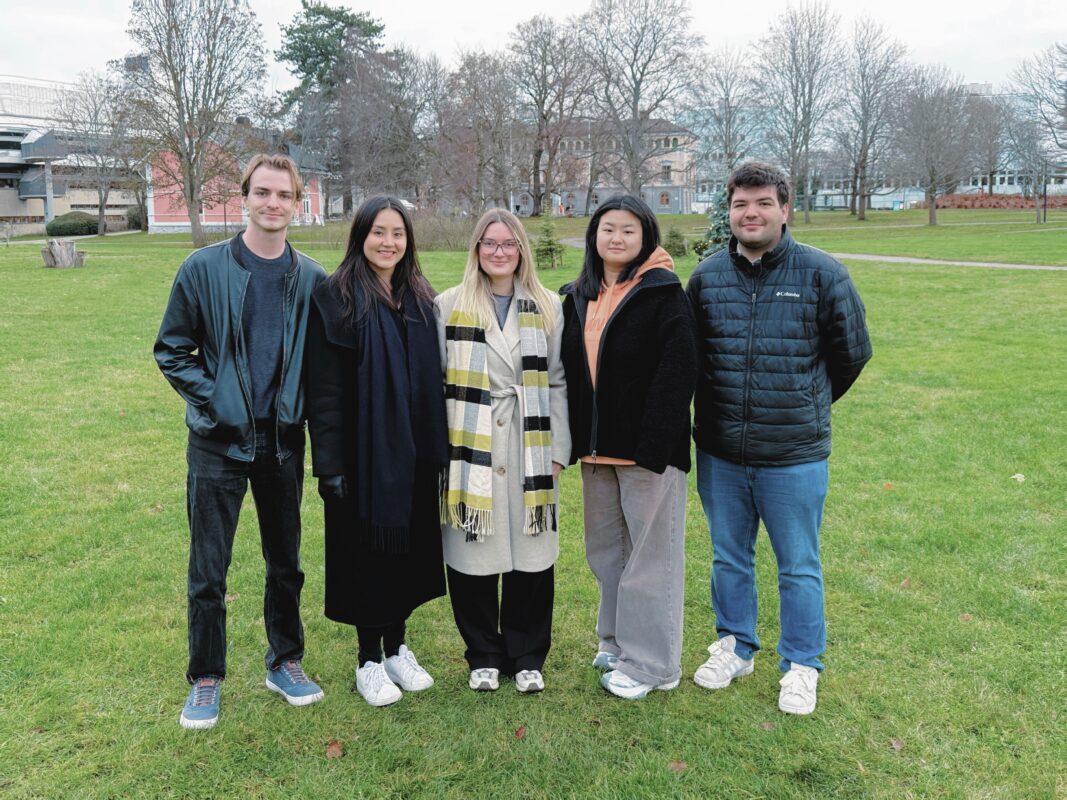
This year, we’re excited to have five talented MSc candidates joining our group for their thesis work: Jake, Jacqueline, Isabelle, Ruchun, and Nikos. Instead of introducing them ourselves, we’ll let them speak for who they are — in the order they appear in the photo.
I’m Jake from Maryland, USA. I have my B.Sc. in Chemistry from the Pennsylvania State University, and I chose to study at Stockholm University because both the courses and research within the analytical chemistry department strongly aligned with my interests. My project focuses on predicting toxicity endpoints by utilizing machine learning. Different workflows will be compared including toxicity prediction from known structure, experimental spectra, and in silico spectra. The aim is to apply these models to predict the toxicity endpoints for features detected in NTS to prioritize chemical identification based on predicted toxicity.
My name is Jacqueline, I’m from Sweden. I completed my Bachelor’s degree at Stockholm University and particularly enjoyed the analytical chemistry module, so I decided to pursue my Master’s degree in analytical chemistry here as well. My project focuses on data-driven LC mobile phase selection in non-target screening. I will develop and train retention time prediction models using data from different mobile phase compositions. These will be used to determine the optimal isomer-selective mobile phase to improve isomer distinction and shorten candidate lists in structural annotation.
I’m Isabelle, and I’m from southern Germany. I came to Stockholm University, and I have been fond of Stockholm as a city. With my degree in analytical chemistry I will have a range of opportunities, whether it be in academia or industry. In my project, I investigate whether LC/HRMS analysis can be made greener by switching to greener organic modifiers without losing analytical performance. I’m comparing a standard method with a greener alternative to assess how the switch to a greener alternative impacts the analytical properties and performance. I aim to uncover trends that demonstrate how switching to greener methods affects what can be observed when analyzing environmental contaminants using non-targeted screening.
I’m Ruchun, I’m from Chengdu, China. I came to Stockholm University a year ago to experience living and studying in Sweden, meet people from different cultures, and learn in a supportive, inspiring research environment where I can grow and find my direction. My project focus on data-driven selection of isomer selective columns for non-target screening. I use molecular features and machine learning to predict hydrophobic subtraction model solute parameters for environmentally relevant isomers. Based on the prediction, I aim to identify stationary phases that provide improved chromatographic selectivity for isomeric compounds that are difficult to distinguish using MS alone.
I’m Nikos and I come from Greece. I was always feeling more inclined towards analytical chemistry, and in my search for what to do in life, this program seemed like a perfect match to help me grow and develop as a scientist. My project is about lignin and contributing to its potential to replace fossil resources. It focuses on the characterization of lignin products derived from oxidative catalytic fractionation, using LC/HRMS to gain insight into lignin’s structure and the mechanisms of its fractionation. Additionally, through in silico generation of lignin dimers I aim to further improve the identification of lignin compounds detected with LC/HRMS.
We hope you’ll all enjoy your time in our group, and we’re genuinely excited to follow your projects as they grow — and to hear all about your findings in the months ahead.